October 22, 2026
ROAS Meaning: What It Is, the Formula, and How to Tell if Your Ads Actually Make Money
 By Rohit GuptaUpdated 13 min read
Your ads dashboard says “ROAS 4.2”. Your agency sends a report with a green arrow. Everyone looks happy.
Then you check your bank account, and the money isn’t there.
Sound familiar?
Here’s the thing: ROAS meaning is simple, but ROAS alone doesn’t tell you if you made money. For that, you need one more number: your break-even ROAS. This guide shows you both, with rupee examples you can copy.
Quick answer: what does ROAS mean?
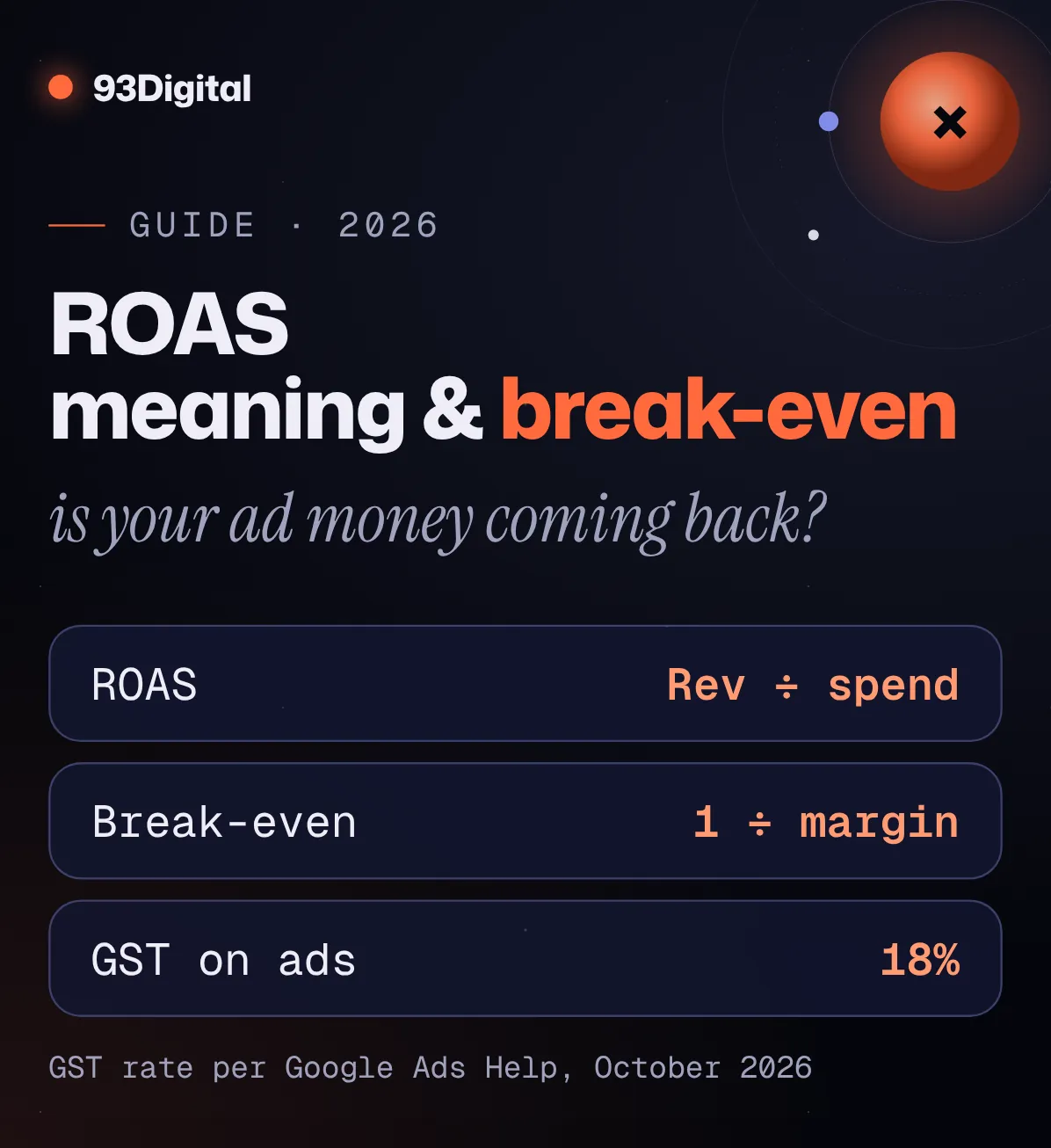
ROAS means Return on Ad Spend: the revenue your ads bring in divided by what you spent on those ads. Spend ₹50,000, make ₹2,00,000 in sales, and your ROAS is 4 (also written 4:1, 4x or 400%).
- Formula: ROAS = revenue from ads ÷ ad spend
- Break-even ROAS: 1 ÷ your profit margin before ads (40% margin → 2.5)
- Above break-even = profit. Below it = loss, even if ROAS looks “good”
- In India: ad invoices carry 18% GST, which raises your real cost if you can’t claim it back
In this guide, you’ll learn:
- How to calculate ROAS and break-even ROAS, with rupee examples
- ROAS vs ROI vs POAS, in plain English
- How GST, COD returns and attribution can make ROAS lie
- Target ROAS bidding, plus a checklist to improve your number
What is ROAS? (ROAS meaning and full form)
ROAS stands for Return on Ad Spend. It tells you how many rupees of revenue you earn for every ₹1 you put into ads. A ROAS of 3 means every ₹1 of ad spend brought back ₹3 in sales.
It answers the first question every business owner asks: “Is my ad money coming back?” In Google Ads, you’ll see it as the Conv. value / cost column.
One catch: ROAS needs a rupee value on each sale. If you run a clinic or coaching centre that collects leads, give each lead a value first (Google Ads lets you set conversion values), or track cost per lead instead.
What is the ROAS formula, and how do you calculate ROAS?
The ROAS formula is revenue from ads divided by ad spend. Add up the sales your ads produced in a period, add up what you spent on those ads in the same period, and divide the first number by the second.
ROAS = Revenue from ads ÷ Ad spend
Here are three ROAS calculations. They’re made-up examples to show the maths, not real businesses.
- D2C skincare brand, Jaipur: ₹50,000 on Meta ads brings in ₹2,00,000 of orders. ₹2,00,000 ÷ ₹50,000 = 4.
- Coaching centre, Indore: ₹30,000 on Google ads enrols 6 students in a ₹12,000 course (₹72,000). ₹72,000 ÷ ₹30,000 = 2.4.
- Home bakery, Kochi: ₹10,000 on Instagram ads brings ₹15,000 in orders. ₹15,000 ÷ ₹10,000 = 1.5.
Quick question: which of these is making money? You can’t tell yet. Hold that thought.
ROAS as a ratio vs % vs “x”
People write the same ROAS three ways. They all mean the same thing:
| Revenue per ₹1 spent | Ratio | “x” | Percentage |
|---|---|---|---|
| ₹1.50 | 1.5:1 | 1.5x | 150% |
| ₹2.40 | 2.4:1 | 2.4x | 240% |
| ₹4 | 4:1 | 4x | 400% |
| ₹5 | 5:1 | 5x | 500% |
Multiply by 100 to get the percentage. Google Ads Help uses the percentage form for target ROAS: 5 in sales ÷ 1 in ad spend × 100% = 500%.
So “400% ROAS” doesn’t mean 400% profit. It means ₹4 of revenue per ₹1 of ads. Revenue isn’t profit.
What is break-even ROAS, and how do you work it out?
Break-even ROAS is the ROAS at which your ads neither make nor lose money. The formula is 1 ÷ your profit margin before ads. If your actual ROAS is above that number, the ads are profitable. Below it, they’re losing money.
Your margin before ads is what’s left from each ₹100 of sales after product cost, packaging, shipping and payment fees, but before paying for ads.
Break-even ROAS = 1 ÷ profit margin before ads
Why does this work? At break-even, the profit from your sales exactly pays for the ads: revenue × margin = ad spend. Divide both sides by ad spend and you get ROAS × margin = 1. So ROAS = 1 ÷ margin.
Back to our examples (margins are assumptions for illustration):
- Skincare, 40% margin: break-even = 1 ÷ 0.40 = 2.5. Actual ROAS 4. Profitable. Profit after ads = (₹2,00,000 × 40%) − ₹50,000 = ₹30,000.
- Coaching, 70% margin: break-even = 1 ÷ 0.70 ≈ 1.43. Actual ROAS 2.4. Profitable.
- Bakery, 30% margin: break-even = 1 ÷ 0.30 ≈ 3.33. Actual ROAS 1.5. Losing money. Profit after ads = (₹15,000 × 30%) − ₹10,000 = −₹5,500.
See that? The coaching centre’s “low” 2.4 is healthy. The bakery’s 1.5 is a leak.
| Margin before ads | Break-even ROAS | If 18% GST isn’t claimable |
|---|---|---|
| 20% | 5.0 | 5.9 |
| 25% | 4.0 | 4.72 |
| 30% | 3.33 | 3.93 |
| 40% | 2.5 | 2.95 |
| 50% | 2.0 | 2.36 |
| 70% | 1.43 | 1.69 |
Worked examples, not benchmarks. Third column = 1.18 ÷ margin, for comparing with the ROAS your ad platform reports on pre-GST spend.
How to use our free ROAS calculator (step by step)
Our ROAS calculator works out your ROAS, break-even ROAS and profit after ads in one go, plus cost-per metrics if you have the numbers. Here’s how to use it.

- Enter “Ad spend (₹)”. Total spend for the period, from Google Ads or Meta Ads Manager. Example: ₹50,000.
- Enter “Revenue from ads (₹)”. Sales those ads brought in over the same period. Use delivered orders where you can. Example: ₹2,00,000.
- Add “Profit margin before ads (%)” (optional). This unlocks break-even ROAS and profit after ads. Example: 40.
- Add “Conversions / orders”, “Impressions” and “Clicks” (optional). These add CPC, CTR, CPM, CPA and conversion rate. Example: 100 orders, 5,00,000 impressions, 5,000 clicks.
- Tick “Add 18% GST to ad spend (if your ad invoices charge GST you can’t claim back)” if that’s you. Leave it unticked if you claim input tax credit.
- Compare ROAS with break-even ROAS. Above it is profit; below it is loss. Then check profit after ads in rupees.
Doing it by hand
With the example numbers above (no GST), ROAS is 4, break-even is 2.5 and profit after ads is ₹30,000. The rest:
- CPC (cost per click) = spend ÷ clicks = ₹10
- CTR (click-through rate) = clicks ÷ impressions × 100 = 1%
- CPM (cost per 1,000 impressions) = spend ÷ impressions × 1,000 = ₹100
- CPA (cost per order) = spend ÷ orders = ₹500
- Conversion rate = orders ÷ clicks × 100 = 2%
The calculator doesn’t connect to your ad accounts or store. It only knows what you type in, so if your revenue includes cancelled or returned orders, your ROAS will look better than it is.
What’s the difference between ROAS, ROI and POAS?
ROAS measures revenue per rupee of ad spend. POAS measures gross profit per rupee of ad spend. ROI measures what you gained after costs compared with what you put in. ROAS is easiest to track; POAS and ROI are closer to “did I make money?”
In shop-owner terms: ROAS asks “how much did I sell per ₹1 of ads?” POAS (Profit on Ad Spend) asks “how much gross profit did I make per ₹1?” Here’s the skincare example:
| Metric | Formula | Example | Break-even |
|---|---|---|---|
| ROAS | Revenue ÷ ad spend | ₹2,00,000 ÷ ₹50,000 = 4 | 1 ÷ margin (2.5) |
| POAS | Gross profit ÷ ad spend | ₹80,000 ÷ ₹50,000 = 1.6 | 1 |
| ROI on ads | (Gross profit − ad spend) ÷ ad spend | ₹30,000 ÷ ₹50,000 = 60% | 0% |
| Break-even ROAS | 1 ÷ margin before ads | 1 ÷ 0.40 = 2.5 | It is the line |
Illustrative numbers. POAS definition and break-even of 1 per ProfitMetrics. A full business ROI would also subtract agency fees, salaries and creative costs.
Which should you track? Use ROAS day to day, because Google and Meta report it for you. But always judge it against break-even ROAS.
What is a good ROAS?
A good ROAS is any ROAS comfortably above your own break-even ROAS. There’s no universal “good” number because it depends on your margin. A 2x ROAS can be great for a 70%-margin course and a loss for a 30%-margin product.
You’ll see blogs say “aim for 4:1.” Treat that as a rule of thumb, not a target. It doesn’t know your margins, return rate or repeat purchases.
Set your own goal instead: start from break-even ROAS, add a buffer for returns and costs the ad platform can’t see, then decide what the ads are for. A brand chasing repeat buyers may accept a lower first-order ROAS on purpose.
How does 18% GST change your ROAS in India?
Google and Meta charge GST on ads bought in India, and online advertising generally attracts 18% GST. If you can’t claim it back as input tax credit, your real ad cost is 18% higher than the spend in your dashboard, so your true ROAS is lower.
What the official sources say, as of October 2026:
- Google Ads: billed by Google India Private Limited at IGST 18%, or CGST 9% + SGST 9% when your “Bill to” state matches the “Bill from” location. GSTIN is mandatory for business accounts. Google adds that you “may not be able to claim credit for taxes that you’ve paid to Google.”
- Meta: Meta announced Indian advertisers would be billed in rupees by its local India entity, and these transactions “will now, by law, be subject to Indian GST.” More in our guide to how Meta ads work.
The GST maths
Skincare example again (hypothetical). Spend in Ads Manager: ₹50,000. With 18% GST: ₹50,000 × 1.18 = ₹59,000.
- GST claimed back: ROAS stays 4. Profit after ads = ₹30,000.
- GST not claimable: ROAS = ₹2,00,000 ÷ ₹59,000 ≈ 3.39. Profit after ads = ₹80,000 − ₹59,000 = ₹21,000.
That’s ₹9,000 a month gone without touching your ads.
Shortcut: when comparing against the ROAS your platform reports (on pre-GST spend), use 1.18 ÷ margin as break-even. At 40% margin, that’s 2.95 instead of 2.5.
One more trap: if your store’s revenue includes GST you collected from customers, that tax isn’t yours. Use revenue without GST. Our free GST calculator can strip GST out of an inclusive amount. And since we’re not tax advisors, confirm input tax credit with your CA.
What is target ROAS in Google Ads (and Meta’s ROAS goal)?
Target ROAS is a Google Ads Smart Bidding strategy. You tell Google the average conversion value you want per rupee spent, and it sets bids to try to hit that return. It only works if you track conversions and give them values.
According to Google Ads Help, as of October 2026:
- You need conversion tracking with values, because Google predicts future value from the values you report.
- It’s set as a percentage. 500% means aiming for ₹5 of conversion value per ₹1 spent.
- There are minimum conversion requirements, for example at least 15 conversions in the past 30 days for Search and Shopping. Other campaign types have their own limits.
- Collect data first: Google suggests reporting values for 4 weeks or 1–2 conversion cycles (whichever is longer) before setting a target.
- Don’t aim too high. A target that’s too high may limit your traffic. After a change, allow 1–2 conversion cycles to settle.
Meta’s ROAS goal
Meta’s version is the ROAS goal bid strategy. Per Jon Loomer’s guide, it’s available in Sales campaigns using the “maximise value of conversions” goal, and needs purchase events with values sent through the Meta pixel. Meta’s developer documentation describes it as a minimum ROAS that Meta bids to meet, and warns that setting it too high may lead to under-delivery.
If this feels like a lot of moving parts, it’s the kind of setup our performance ads team handles every day.
Why can ROAS mislead you?
ROAS can mislead because the revenue behind it is often overstated or double-counted. Attribution rules, two platforms claiming the same sale, returned or undelivered orders, and ignored repeat purchases can all push ROAS away from what actually reached your bank.
- Attribution is credit, not proof. Meta’s default attribution setting is 7-day click and 1-day view (per Jon Loomer). Google Ads uses data-driven attribution by default for most conversion actions. The same order can show up in both dashboards.
- COD and RTO. Amazon Shipping’s blog, citing Shipway’s ShipNotes FY25 report, puts RTO (return to origin) at about 26% for COD orders vs under 2% for prepaid. If ROAS counts orders placed, not delivered, it’s inflated.
- Returns. A returned order still counts unless you correct it. Google Ads supports conversion adjustments to retract or restate returned or cancelled purchases.
- Repeat purchases are invisible. First-order ROAS ignores customers who come back next month.
- Revenue isn’t profit. A 5x ROAS on a 15%-margin product still loses money (break-even ≈ 6.67).
Quick check: say 15% of ₹2,00,000 in ad revenue never gets delivered (a made-up figure). Real revenue is ₹1,70,000, and ROAS drops from 4 to 3.4, before you pay shipping both ways.
How can you improve your ROAS?
You improve ROAS by earning more revenue from the same spend, or spending less for the same revenue. In practice, that means clean tracking, real delivered revenue, stronger offers, better landing pages and cutting what doesn’t pay.
- Fix tracking first. Purchases should fire once, with the right rupee value, on Google and Meta.
- Measure delivered revenue. Remove cancelled, RTO and returned orders, or adjust conversions in the platform.
- Nudge buyers to prepaid. A small prepaid discount or an easy UPI payment option can reduce COD risk.
- Cut the losers. Pause campaigns and keywords stuck below break-even ROAS for a fair stretch.
- Raise order value with bundles, combos and free-shipping thresholds.
- Improve the landing page. Faster pages, clear prices and fewer checkout steps convert more clicks.
- Refresh creatives. Test new hooks, videos and offers instead of running one ad for months.
- Move to value-based bidding once you have data. Target ROAS or Meta’s ROAS goal, set above break-even.
Want a team to run this checklist on your account? See how our Google and Meta ads management works.
ROAS meaning: frequently asked questions
What is the full form of ROAS?
ROAS stands for Return on Ad Spend. It’s the revenue your ads generate divided by what you spent on those ads. A ROAS of 3 means ₹3 of sales for every ₹1 of ad spend.
How do you calculate ROAS?
Divide revenue from ads by ad spend for the same period. ₹1,20,000 in sales from ₹40,000 of ads gives a ROAS of 3 (3:1, 3x or 300%). Use delivered revenue, not orders placed, for a truer number.
What is a good ROAS?
There’s no single good ROAS. A good ROAS sits comfortably above your break-even ROAS, which is 1 ÷ your margin before ads. With a 50% margin, anything above 2 is profitable; with a 25% margin, you need more than 4.
What is break-even ROAS?
It’s the ROAS where your ads neither make nor lose money: 1 ÷ your margin before ads. At a 40% margin, break-even ROAS is 2.5. If you can’t claim back the 18% GST on ad invoices, use 1.18 ÷ margin instead.
Is ROAS the same as ROI?
No. ROAS compares revenue with ad spend. ROI compares what you gained after costs with what you invested. You can have a ROAS of 3 and still lose money if your margins are thin.
What does a ROAS of 400% mean?
It means ₹4 of revenue for every ₹1 spent on ads, the same as 4:1 or 4x. It doesn’t mean 400% profit. At a 40% margin it’s profitable; at a 20% margin it isn’t.
Does GST affect ROAS in India?
Yes, if you can’t claim it back. Google and Meta charge GST on ads in India, and online advertising generally attracts 18%. If that GST is a real cost to you, divide revenue by (spend × 1.18) for your true ROAS. Confirm input tax credit with your CA.
What is target ROAS in Google Ads?
A Smart Bidding strategy where Google sets bids to hit the average return you choose, entered as a percentage like 500%. It needs conversion tracking with values, and Google lists minimums such as 15 conversions in 30 days for Search and Shopping.
Sources and how we researched this
We researched this guide in October 2026, reading Google Ads Help on target ROAS, conversion values, attribution, conversion adjustments and Indian taxes, Meta’s developer docs and India billing announcement, and published sources on GST and RTO. All worked examples use hypothetical numbers. We don’t quote “average ROAS” benchmarks, because they rarely match any one business’s margins.
- Google Ads Help: About target ROAS bidding (value requirement, 500% example, minimum conversions, timing)
- Google Ads Help: Conversion values (conversion value/cost, value-based bidding)
- Google Ads Help: Taxes in your country (India GST rates, GSTIN)
- Google Payments Center: GST on purchases (Google India Private Limited, IGST vs CGST + SGST, credit caution)
- Google Ads Help: About attribution models (data-driven default)
- Google Ads Help: About conversion adjustments (returns and cancellations)
- Meta for Developers: Bid strategy (minimum ROAS bidding, under-delivery warning)
- Meta Newsroom: Local selling model in India (INR billing, Indian GST)
- Busy: GST on advertisement services (18% on online advertising, input tax credit)
- Amazon Shipping India: What is RTO (COD vs prepaid RTO, citing Shipway ShipNotes FY25)
- ProfitMetrics: What is POAS (definition, formula, break-even of 1)
- Jon Loomer: Meta bid strategies (ROAS goal requirements)
- Jon Loomer: Meta attribution setting (7-day click, 1-day view default)
Spotted a number that’s changed? Tell us and we’ll update this guide.
The bottom line
ROAS meaning in one line: revenue from ads ÷ ad spend. It’s the fastest way to see whether ad money is coming back.
But a “good” ROAS isn’t a number you copy from a blog. It’s whatever sits comfortably above your break-even ROAS: 1 ÷ your margin, adjusted for GST you can’t claim and orders that never arrive.
Work out that one number this week. It’ll change how you read every ads report.
Want someone to look at your ad accounts and tell you which campaigns make money and which just make noise? Get a free growth audit and we’ll walk you through it.
Founder of 93Digital. Rohit has worked in SEO and digital marketing since 2007, through every major Google update, and runs paid ads with one rule: a campaign has to pay for itself.